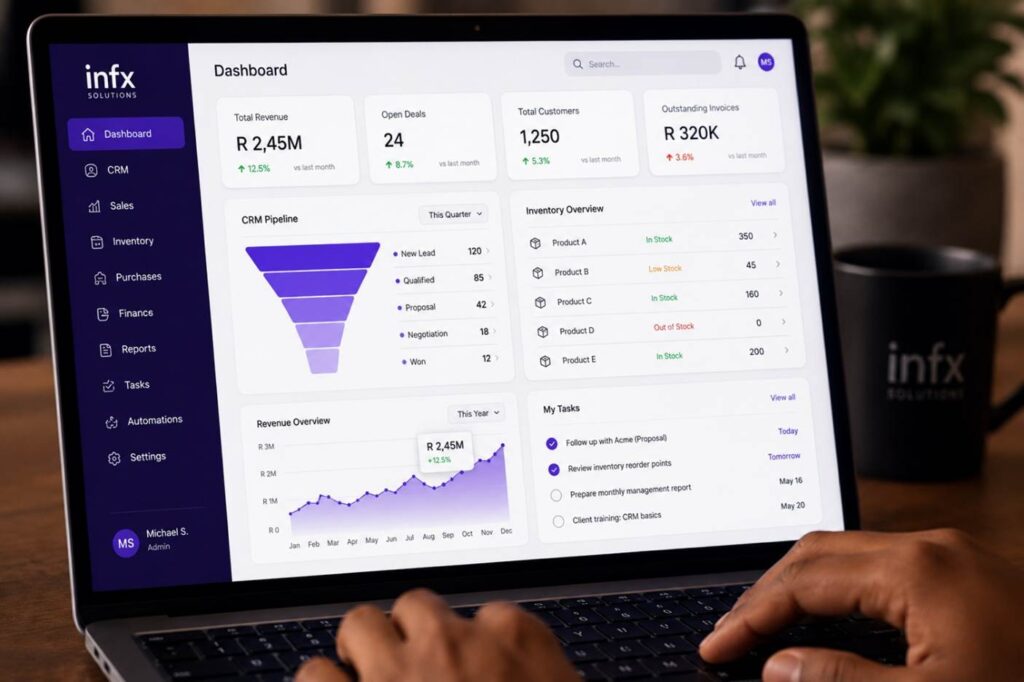
The Ceiling Nobody Talks About
There’s a moment most growing South African businesses hit, usually somewhere between 10 and 50 employees, where the systems that got them here stop being assets and start being obstacles.
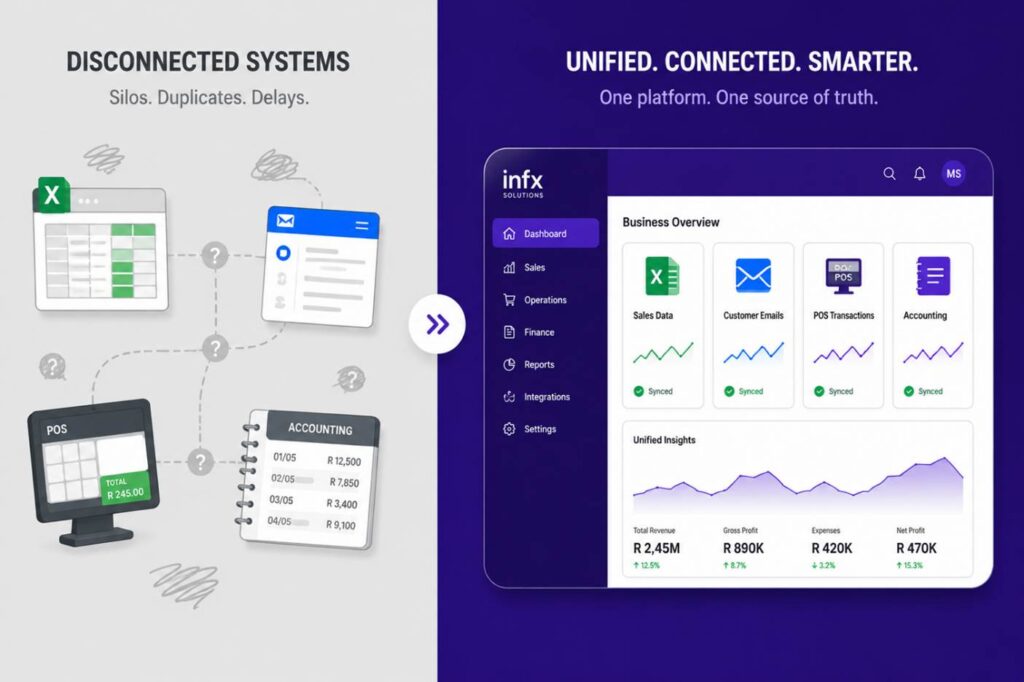
Sales are tracked in a spreadsheet. Customer follow-ups live in someone’s inbox. Stock is counted manually at month-end. The accounting software doesn’t talk to the CRM. The CRM doesn’t talk to the POS. And the business owner spends half their Monday piecing together a picture of where the business actually stands.
This isn’t a discipline problem. It isn’t a staffing problem. It’s a systems problem, and it’s far more common than most business owners are willing to admit, because admitting it feels like admitting something’s wrong with the business itself.
It isn’t. The business is fine. The infrastructure holding it together just hasn’t kept pace with its growth.

What Fragmented Systems Actually Cost
The instinct is to measure this in hours (how long does it take to reconcile a report, chase a purchase order, update a customer record across three platforms). And yes, those hours add up. INFX clients typically recover 10 or more hours of admin time per week once their systems are unified.
But the deeper cost is less visible. It shows up in the decisions that don’t get made because the data isn’t reliable enough to act on. In the customer experience that slips because one team’s record doesn’t match another’s. In the scale that doesn’t happen, not because the market isn’t there, but because the operation can’t hold more weight.
Fragmented systems don’t just slow you down. They put a ceiling on how far you can grow before something breaks.
The South African SME Reality
Building integrated systems in a South African business context comes with its own set of constraints: load shedding, variable connectivity, a mix of formal and informal processes, and the very real pressure to do more with leaner teams than your global counterparts.
Global software platforms weren’t built with these realities in mind. Which is why implementation matters as much as the tools themselves. The right platform, configured for how your business actually works, by a partner who understands the local context, that’s the difference between software that sits unused and systems that genuinely scale your operation.
What Unification Actually Looks Like
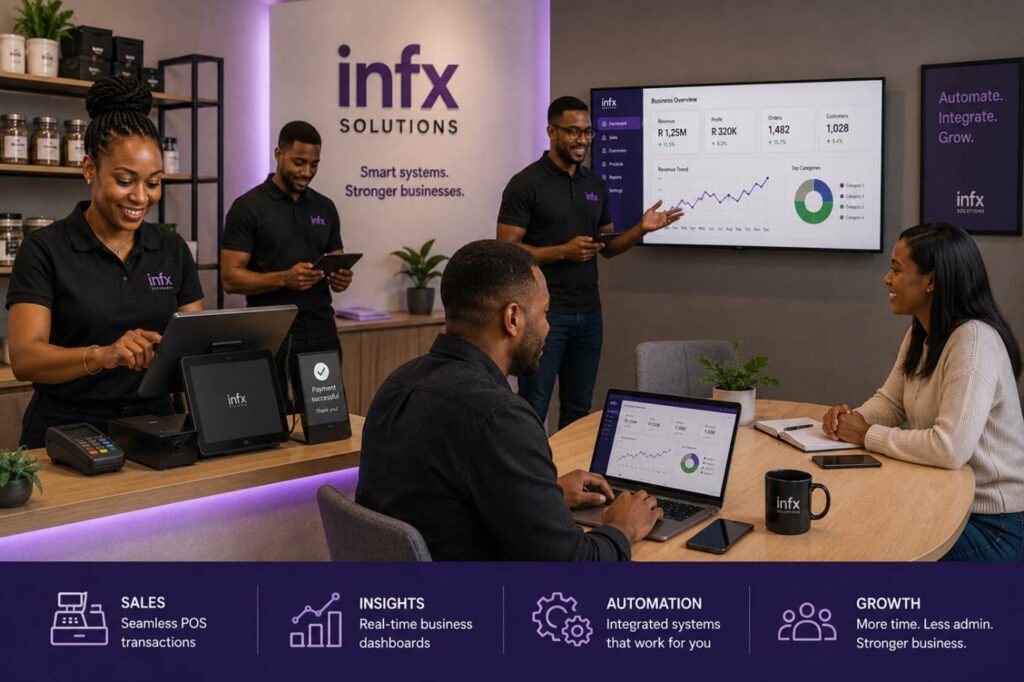
When INFX talks about moving a business from fragmented to unified, we’re not describing a theoretical future state. We’re describing a specific, practical outcome: one login, one data source, one operating environment where sales, finance, inventory, customer management, and operations all speak the same language.
That looks different depending on where you are in your growth journey. For a retail business, it might mean your POS connects to your inventory management, which connects to your accounting, which connects to your customer database, live, not at month-end. For a services business, it might mean your CRM pipeline feeds directly into your project workflow, which triggers billing automatically when a milestone is hit.
The specifics vary. The outcome doesn’t: a business where the systems work for the people, not the other way around.

The First Step Is the Simplest
Most businesses don’t need a full digital transformation on day one. They need a clear picture of where the friction lives, and a roadmap for addressing it in the right sequence.
That’s how INFX works. We start by documenting your current processes, identifying where the gaps are costing you the most, and building smart systems that address those gaps without disrupting what’s already working.
The goal isn’t to replace your business. It’s to build the infrastructure that lets it grow into what it’s capable of becoming.